
Milo's Journey
Chapter 1

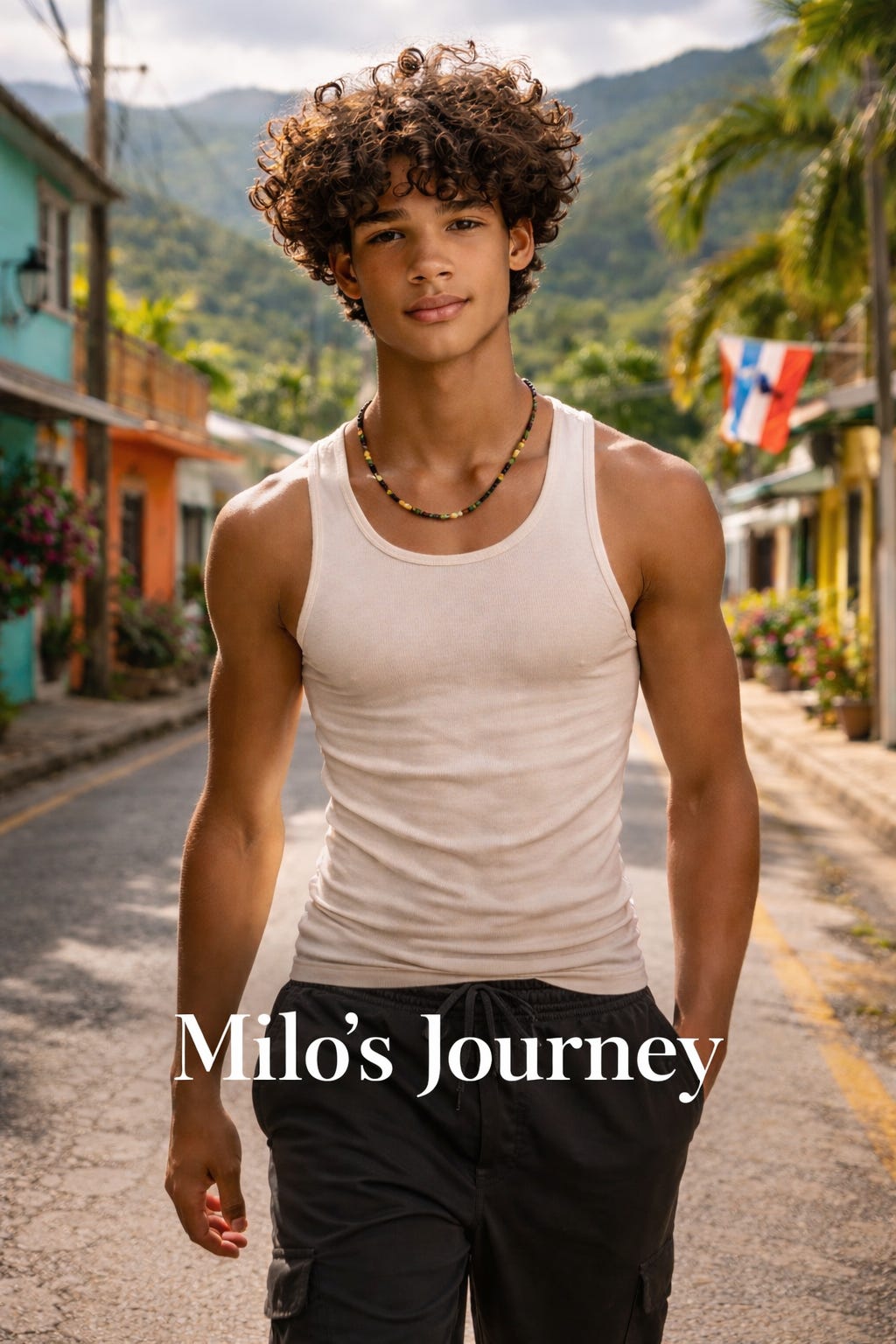
Milo Santiago stood beneath the shade of a towering palm tree, his dark, curly hair catching the faintest breeze that blew through the quiet streets of Jayuya. His lean, athletic build was a testament to his active life. In the mornings before school, and most afternoons upon his return, Milo toiled on his parents’ modest farm. When he wasn’t tending to the land, he offered consultas—readings to the villagers—for extra income. This financial support was crucial when the farm’s crops struggled to flourish.
The town where Milo and his mother, Natalia, lived was nestled in the mountains at the center of Puerto Rico, surrounded by verdant hills and the scent of tropical flowers drifting on the air. The sun cast long shadows on the cobblestone streets, and the atmosphere was heavy with the weight of history. This was a place where generations of families descended from the Taínos had built their lives, their stories woven into the very fabric of the town.
People went about their day-to-day lives, the hum of conversation filling the air as they greeted each other warmly. It was a close-knit community where everyone knew their neighbors, and news traveled by word of mouth faster than any newspaper. But within this tapestry of ordinary life, there were threads of something more. The voices of the past echoed in the streets and whispered from the shadows.
For Milo, these voices were very real. He had heard them since he was a small child. To him, they were an invitation to explore the mysteries that lay hidden just beneath the surface, waiting to be uncovered. Milo had a deep connection to the muertos—the dead. It was a bond that had been passed down through his family for generations. In a place like this, where the past and present seemed to merge into one, Milo felt their presence all around him.
As Milo walked along the worn streets, his thoughts turned to his mother. Their relationship was fraught with tension, rooted in her fear of the power that flowed through their bloodline. Natalia had rejected her gift. She had turned her back on the muertos and chosen another path. Her choice left Milo as the one who inherited the power she refused. The family gift passed to him on the day he was born.
That day was the last day Natalia saw the muertos.
As she held Milo for the first time, she looked over his small head, and standing at the foot of her bed were her grandmother, great-grandmother, her grandfather, great-grandfather, several Taíno warriors, and a magnificent Taíno chief. Instinctively, she knew these souls had been waiting for Milo to be born, and their presence was the testament to the power he would soon inherit.
The muertos smiled at her, and then her grandmother put her hand over the baby’s head as if in blessing. After a moment, she smiled and nodded, and then all of them faded away. Natalia knew from that day forward Milo’s life would belong to the dead. She knew she could not teach him, but her mother could, and so she lovingly set her son on the path chosen for him by the dead.
Milo never feared the dead, and he refused to be defined by his mother’s fear. He was determined to master his spiritual gifts and to use them for the betterment of their community and the world beyond.

The flickering candlelight cast shadows on the walls of Milo’s small consultation room.
A small altar stood on the wall behind him. Statues of Indian warriors and African slaves surrounded a set of seven glasses of water arranged in a circle. Candles burned on the altar, and to the right stood a large statue of an African chief. Milo sat at a small table covered by a white cloth, with a candle to his right and a glass of water to the left.
Across from him sat a middle-aged woman named Esmeralda, her hands tightly clasped together, her eyes filled with equal parts hope and desperation. She had come to Milo seeking help in finding her husband, who had vanished without a trace.
“Please,” Esmeralda whispered, her voice quivering with emotion.
“I need to know where my husband is—if he’s safe.”
Milo nodded solemnly, sensing the depth of her pain. He reached across the table and grasped her hands. He closed his eyes and recited the Lord’s Prayer, the Hail Mary, and the Glory Be quietly, breathing deeply and asking for God’s protection.
“Negro Juanito, we seek your guidance. Open the gate and stand guard,” he murmured, knocking on the table three times with his right hand.
“We ask for your help. Open our eyes and help us to know what is true.”
With his eyes closed, Milo felt a presence enter the room—a warm and comforting energy that seemed to wrap itself around Esmeralda like a protective embrace. He knew it was her protecting spirit, reaching out to offer solace and reassurance.
“Esmeralda, La Madama is here. I know you can feel her around you.”
Milo waited for her to nod affirmatively. Tears welled in her eyes as she listened to his words. Relief and gratitude washed over her face, but so too did lingering uncertainty.
“I have felt her a lot recently,” she said, her voice barely a whisper.
“Yes, I know. She is here with us now, and she is telling me not to shed any more tears for that man. She has watched over you for the past seven years—while you cooked, cleaned, and were a faithful wife, while he came home drunk, beat you, disrespected you, and slept around with loose women.”
Milo’s voice was soft, but steady.
Esmeralda nodded, and tears began to fall. Milo grasped her hands again.
“La Madama says that she is why he is gone. She swept him out with her broom like the trash he is. She warns you not to pick him up again. Trash on the doorstep is only worth sweeping into the street.”
“She says to go home, wash your face, and cook a big pot of sancocho. The first bowl you will give to her. Then have your dinner, and if anyone knocks on your door for the next seven days, you must offer them a bowl of this soup.”
“The tongues of the villagers have been wagging about your misfortune, and she will use this soup to help them realize they were wrong in choosing your husband’s side. You are not to worry any longer. She has covered you with her skirt, and you will be okay.”
“La Madama is a powerful being. Trust in her. She knows struggle and hardship, but she has always managed to turn it around—and she will do the same for you.”
Esmeralda smiled through her tears and pressed the five dollars for the reading into his hands.
“Thank you, Milo. I will do as she advises. God and the muertos bless you.”
Esmeralda left with renewed faith in her heart.
Milo knew she would be all right. No one messed with La Madama. When she put her broom to work, you prayed she only used it to sweep the trash out.
He tidied up the room and went to the altar to say his parting prayers.
“Negro Juanito, thank you for standing at the gate. Close it for me and know you have my gratitude.”
Anytime, mi caballo, came the response in Milo’s head.
He smiled and looked at the African statue standing at the side of the altar.
“Buenas noches, mis muertos.”
Milo bowed to the altar, then left the small room, walking out of the barn and down the path to the house.

The fading light of the setting sun cast an ethereal glow upon his face as he sat on the porch of his family home, reflecting on the day’s events. The cool breeze rustled the leaves of the ancient palm tree nearby, carrying with it the distant sounds of laughter and conversation from the town below.
Despite the beauty of the scene before him, Milo’s thoughts went back to his session with Esmeralda.
“I’m glad I was able to help her,” he said softly,
“and I’m glad that her guardian spirit, La Madama, decided to help.”
“Abuela Mireya always said that the muertos would guide you, Milo,” Natalia gently reminded him, appearing at the doorway with a tray of steaming cups of tea. “With each person you help, you honor her legacy and keep our family’s traditions alive.”
“I knew the day you were born that you would walk the road I couldn’t walk. You were only minutes old when the muertos came to greet you—and to say goodbye to me. Your great-grandmother put her hand over your head in blessing, and I knew you would be the one to carry on the family’s legacy.”
“That was the last day I saw the muertos, but I knew they were near—always looking out for you.”
“Wow, Mamá,” Milo said, accepting the tea with gratitude. “You never told me that story.”
He wrapped his hands around the warm cup, feeling the heat seep into his bones. Along with the warmth came a deeper connection—a sense of belonging to a lineage that stretched back generations. Within that connection, he felt the presence of Abuela Mireya, her guidance ever-present even in death.
“Espiritismo and La Mesa Blanca—the white table—have been part of our family for centuries,” Natalia continued, her eyes distant as she recalled the stories passed down through the generations. “Our ancestors used their gifts to heal, to protect, and to bring light to those who dwelt in darkness.”
“Yet sometimes,” Milo confessed, his voice low and edged with vulnerability, “I fear that I may not be equal to the task. The world is vast and complex, and every day I face new challenges that test my abilities.”
“Your heart is pure, Milo,” Natalia said, her voice filled with conviction. “You were meant to do this work, and you are stronger than I am. Your grandmother said she had never seen a gift as strong as yours.”
“Still, sometimes I wonder if it’s enough,” Milo admitted, his gaze fixed upon the horizon as he grappled with the enormity of his calling.
Natalia placed a reassuring hand on her son’s shoulder, her eyes shining with pride.
“Your dedication to helping others is a testament to your character, Milo. You have a strong moral compass and a genuine desire to make a difference in people’s lives. That is all anyone can ask.”
“Thank you, Mamá,” Milo whispered, his spirit buoyed by her words.
As he gazed out at the town below, a renewed sense of purpose filled his heart. With each person he helped, he was honoring the legacy of Abuela Mireya—and all those who had come before him.
This is a beautiful opening. I really liked how ancestry, spirituality, and everyday life are woven together so naturally. I could really feel the weight of Milo’s responsibility as I read, especially in how he cares for others.